


Reclaiming Time: Part 3 in the "Mom's Bold Return" Series

Updated: Apr 14

In Part 2 of the "Mom's Bold Return" series, we identified your 'Next Move.' You felt the spark of a career pivot or the excitement of a new launch. But then, you might have looked at the kitchen counter, the laundry, and the school calendar and thought, "There isn't a single spare second in my day. I’m already at 100% capacity.”
Between the physical demands of the house and the emotional needs of your family, it can feel like your schedule isn't actually your own anymore.
In Part 3 of the Mom's Bold Return blog series, you will learn 3 strategies to "create" the time you need in your busy life to launch your professional identity within motherhood.
Here is a reminder of the Eisenhower Matrix we discussed in Part 1. As a busy mom, it may feel like your time and energy are being held hostage by the Urgency Trap that resides in quadrants 1, 3 & 4. However, the ideal place to find focused time to pursue your professional identity lies in quadrant 2.
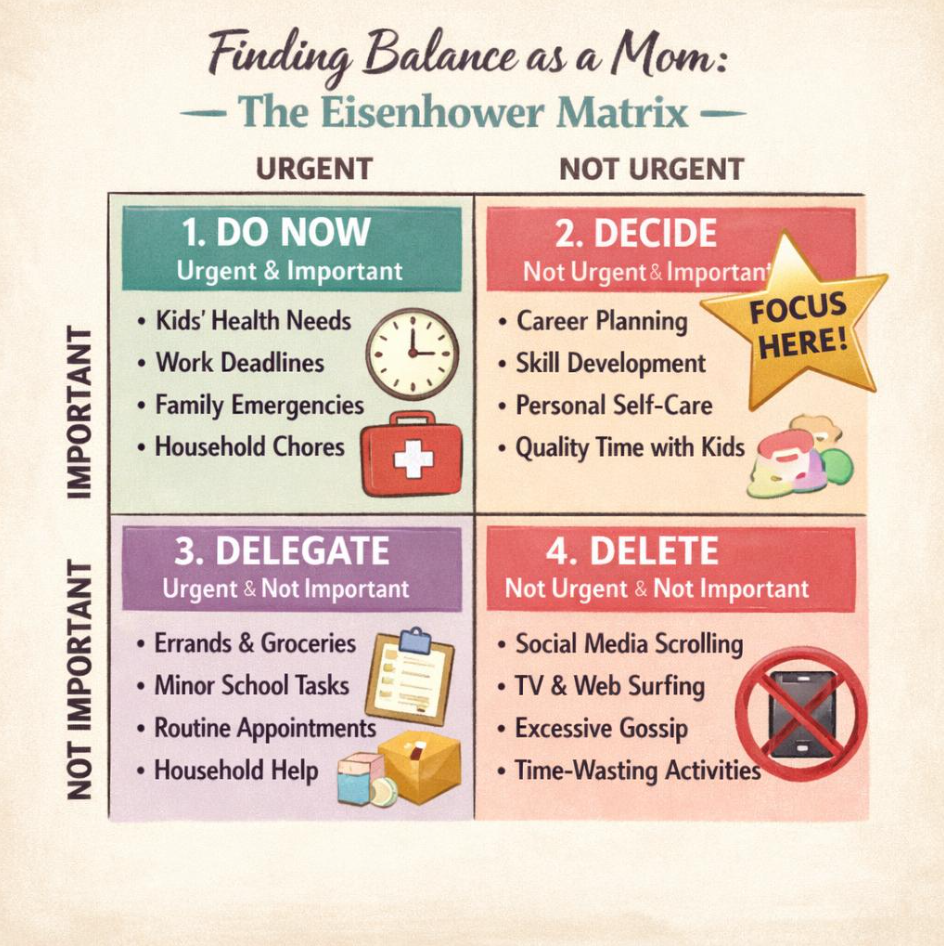
Reclaiming your time isn't just about finding extra hours in an already exhausting day; time needs to be reclaimed by redesigning your week with strategy and boundaries to move from being busy to being effective.
The "I’m Already Full" Fallacy: The Lie That Keeps You Stuck
A common misconception is that to start something new requires a vast, empty expanse of time. You might be waiting for the kids to be older or for life to settle down before you begin.
This is the "I'm Already Full" Fallacy: the belief that time will eventually present itself.
The harsh reality is that time for your professional identity must be carved out of the current chaos, rather than waiting for the chaos to end.
The paragraphs will guide you through 3 methods to reclaim time and effectively establish your professional identity.
By expanding your mental capacity, setting defined time blocks, and establishing boundaries, you can accomplish everything important to you while effectively avoiding burnout from attempting to 'do it all.'
1. Audit Your Mental Load: The Mindset Shift to Free Your CEO Brain
In the context of motherhood, the Mental Load refers to the non-stop "tab management" of running a household. It’s remembering library book day, doctor appointments, and grocery lists.
These immediate tasks take up the "cognitive bandwidth" you need for your professional brain to breathe.
The goal of this audit is to hit 'Ctrl+Alt+Del' on your domestic brain to free up space for your CEO brain.
So the first step is to reclaim time by doing a compassionate, yet deliberate, audit of the load you're carrying.
Exercise:
Grab a paper and pen (the visual will be very helpful here) and divide the page into 2 columns; one wide column on the left and one narrow column on the far right.
In the wide column on the left, make a list of all the things you did yesterday, including the things you didn't get to, and the things you thought about doing. The list is going to be VERY LONG!
When completed, put down the pen and take a moment to visualize yourself living out your professional identity while simultaneously being the fantastic mother that you are. This visualization step is crucial to being able to execute the next step.
With this visualization in your mind, ask yourself, what did I need to do to get to this point? Now look at the list you just created and, one by one, write the following words beside each task in the narrow column on the far right: Delegate, Delete, or Delay. You must write one of the “D” words beside every task. Even if it isn’t exactly how it would be executed in your real life, the exercise will force you to creatively come up with a way that you can.
Here are the definitions to help you decide:
Delegate: What can your partner, parent, neighbour, friend, a service, or an older child take over?
Delete: What "urgent" tasks are actually non-fulfilling or low-value busy work that can be dropped completely?
Delay: What can wait until a day or time that is not a focused time for your profession?
Now, sit back and look at your list. With every item on your ‘to-do, want-to-do, or did-not-do’ list successfully delegated, deleted, or delayed, how do you feel? Do you feel like you might have a little bit more mental bandwidth and time to pursue your professional identity?
This exercise is intended to help you find the space between the tasks. The 'A-ha' moment comes when you realize that your exhaustion hasn't been caused by a lack of ability, but by a lack of mental bandwidth from being pulled in so many directions.
As you look at your list now, vetted through the lens of Delegate, Delete, and Delay, you should see a clearing in the woods.
The weight you feel isn't because you aren't 'doing enough'; it’s because you’ve been carrying the mental load of three different roles at once!
By assigning a D-word to every task, you aren't just clearing a to-do list; you are reclaiming your intellectual real estate. You are proving to yourself that when the noise of domestic management is intentionally quieted, the professional woman you miss is still standing there, ready to work.
If seeing this list on paper is making your heart race, or if you're finding it impossible to assign a D-word to every item, I encourage you to take advantage of a complimentary 30-minute Mindful Chat, and let’s look at that list together.
2. Create Dedicated “Time-Blocks” of Productivity: Building Sustainable Momentum
Now that you’ve cleared the mental fog through your audit, it’s time to find where those reclaimed minutes actually live.
A Time-Block is a non-negotiable, designated period when you are officially "at work." It doesn't matter if you are in a high-rise office or sitting at your kitchen table with a cold cup of coffee. When you are in a block, you have your professional hat on.
Because your life as a mother is unpredictable, we’re not necessarily looking for a traditional 9-to-5 block. Instead, we’re looking for strategic pockets of time. Crucially, you are reserving this time exclusively for the Important but Not Urgent tasks (see above) that shape your professional identity.
Here are five ways to build time-blocks that respect both your ambition and your reality:
Capitalize the Early Bird or The Night Owl Hours: Identify the one 60-minute "Golden Hour" per day where you have the most natural energy and least chance of being interrupted. Is it before the house wakes up or after the world settles? This is the time you will put on reserve for deep focus work that requires your best brain. By being consistent with just one hour, five times a week, and learning to say 'no' to distractions, you build your focus muscle, making it easier to switch into "Mom is Working" mode.
Become a Nap-Time CEO: You don’t need an eight-hour day to make an impact; you need a focused one. Utilize the quiet midday block to be the "CEO" of your venture, handling high-level decisions or creative execution while the house is still.
Implement a “Deep Work Day”: Similar to how a full-time working partner departs 5 days a week for work while you stay home, designate one full day (or a 6-to-8-hour block) where a partner, grandparent, or sitter is 100% in charge so you can do deep focused work. Don't forget that a Saturday or Sunday might be a perfect day.
Consider this day a non-negotiable business expense, an investment in the focus and energy that will power the rest of your week. Leave the house, go to a library, find a quiet corner in a café, or create a dedicated workspace.
This isn’t the easiest method to execute, but if you can, it does more than give you time to focus; it trains your family to see you as a professional and gets the kids used to the idea that you can be "away" while they are safe at home.
It might seem like your deep work day is taking away from precious family time, but it is only temporary. Once your profession is established and everyone is used to the idea of mom being away, the family routine and balance will rectify itself.
Deploy Your Networking Skills on the Playground: Your social time doesn't have to be "off" time. Use playdates or park trips strategically. Mention your career pivot or your business to other parents. Ask how they reclaim time to focus on work. You’ll be surprised by how many brilliant ideas, leads, or partnerships are sparked when you start talking shop with your community.
Maximize Your Passive Time: Utilize the inevitable "in-between" moments like waiting in the school car line or sitting at sports practices. This is an ideal time to tackle low-level tasks like responding to emails, scheduling, or listening to industry-related podcasts.
The secret to creating dedicated time-blocks isn't finding a massive amount of time; it’s knowing the predictability of the time you have. When you know exactly when your next "Golden Hour" or "Deep Work Session" is coming, your brain stops panic-looping about when you’ll get things done.
You move from a state of frantic multi-tasking to a state of calm, professional momentum. Even if you start with just three blocks a week, you are no longer just thinking about work or starting a business; you are officially working.
3. Establish "Mom is Working" Boundaries: Protecting Your Focus and Your Peace
Identifying your next move and building a schedule is an exhilarating start, but without boundaries, the reality of home life will quickly bleed into your professional space. For many mothers, this is the hardest part.
Many mothers experience a wave of guilt the moment they say 'no' to a request or make time to focus. Without solid, predictable, family-acknowledged boundaries, children may struggle to understand this as well.
This can lead to a mother's frustration and hinder her success in reclaiming time to pursue her professional identity.
When you sit down and try to draft a proposal while simultaneously fetching juice boxes, you are caught in the trap of "Half-Working and Half-Mothering." You aren't fully present for either, which leads to a cycle of frustration, resentment, and eventual burnout.
To reclaim your professional identity, transition from a state of constant availability to one of intentional focus.
Here are 5 methods to build boundaries that protect your work and your peace:
Utilize a Physical Work Signal:
Because children (and often partners) are visual learners, having a clear, physical cue that signifies you have shifted roles is essential. This could be a closed office door, a specific pair of noise-canceling headphones, or even a designated work hat or scarf. When the signal is on, it’s the universal sign that you are in work mode and should only be interrupted for true emergencies.
Script Your Communication:
Boundaries work best when they are pre-explained, not enforced in the heat of a frustrated moment. Sit your partner and children down and explain your new venture. Use clear, age-appropriate language: "On Tuesday mornings, Mom is building her business in the den. This is my 'Focus Time' so that I can be fully present with you when we have our 'Together Time' later." Explain why this is important and the benefits that will arise for the entire family from your success. By explaining the "why," you turn a barrier into a shared family goal.
Shift Your Mindset to Inspire By Example:
The greatest hurdle is often our own internal narratives. You aren't ignoring your family when you choose to work; you are modeling focus, ambition, and self-respect. When your children see you prioritizing a goal, you are teaching them that a woman’s identity is multifaceted and that professional passion is a healthy part of a full life.
Gamify the Success:
Get your children involved in the boundary and share your wins with them. This can be something simple like having them create a "Mom At Work" sign they can color, or set a timer they can watch. Or it can be tied to your goals. When Mom lands a new client or finishes a project, everyone gets a special dessert.
When they see that your focus time leads to a result, they begin to view your work time as a respected, immovable block of the family’s collective success.
Success in the long run depends on your family viewing your work time not as a takeaway from them, but as a dedicated part of who you are. As these boundaries become a predictable part of your family rhythm, the friction begins to disappear.
You’ll find that when you finally step out of your "work block," you are actually a more patient, energized mother because you’ve spent focused time being the professional woman you’ve missed.
An Example: Jenna’s Transition from "Busy" to "Business"The Dream: Jenna dreamed of pivoting back into Interior Design Consulting, but as a stay-at-home mother, she couldn’t imagine where she would find the time to land new clients, let alone meet with them. The Mental Load Audit: Jenna started with a mental load audit and had a major "a-ha" moment: she was spending hours every week on school volunteer tasks that didn't actually fulfill her. By deleting these low-impact obligations, she cleared the cognitive bandwidth to move into her planning stage. The Time-Blocks of Productivity: Jenna began with just five hours a week, utilizing her early bird hours before the house woke up to build her portfolio. As her confidence grew, she scaled her schedule to meet the demands of a real business:
Boundaries With Family Integration: Jenna didn’t just set boundaries; she gamified her success. Every time she landed a new client, the kids got an extra hour of "movie night" on Saturdays. In addition, when a design project was completed, the whole family visited the site to take a commemorative photo. This turned her professional "absence" into a shared family celebration. The Result: By creating a predictable system and protecting her mental space, Jenna successfully operates a boutique design firm, managing one to two clients at a time while working a solid 20 hours per week. Jenna still considers herself a full-time mother, but she is now a mother with a thriving professional identity that enriches her spirit and brings a newfound balance to her home. |
You've Now Reclaimed Time to Grow Your Professional Identity
You are no longer just reacting to the urgent needs of others; you are intentionally designing a life that has room for every version of you.
By auditing your Mental Load, you’ve cleared the cognitive fog.
By building your Time-Blocks of Productivity, you’ve moved from thinking about a business to actually operating one in strategic pockets.
And by establishing Boundaries, you’ve transformed your work time from a source of family friction into a shared family value.
Consider this reminder: Reclaiming your time is not a one-time event; it's an ongoing practice that involves recognizing and valuing your potential. This practice may need to evolve as your family's needs and dynamics change. If you're finding it challenging to reclaim the time you once had, perhaps because your baby has stopped napping or your teenagers require more transportation, take a moment to reassess your situation.
Your Professional Identity is Not a "To-Do" Item
Remember, your professional identity is not just another task to fit into an already busy day; it is the very thing that will give you the energy to handle the rest of your life with more grace and purpose.
You will find a level of presence that makes you a more energized parent and a more effective professional. You have the tools, the strategy, and the permission to start today.
You are no longer waiting for the right time; you are the architect of it.
Next in the "Mom's Bold Return" series: Ready to Launch
Part 1: Rediscover Your Professional Identity - You navigated the urgency trap and embraced your value.
Part 2: Identify Your Next Move - You decided the path forward was a career pivot or a creative launch by applying “Life-Fit” filters and testing your MVI to start taking action.
(This post) Part 3: Reclaiming Time - You audited your to-do list, created time-blocks, and established boundaries to create the time to do everything.
(Next) Part 4: Ready to Launch - Learn to navigate the hurdles, and own your debut!
Ready to Reclaim Your Time?
Time is the currency of your new identity. Stop spending it all on 'urgent' chores and start investing it in the woman you are becoming. Book a complimentary 30-minute chat, and let's build a schedule that respects both your family and your self-growth.
Liisa Wagner
Discover Your Path, Design Your Life


Comments